


If you want to understand the real differences between European-style cranes and traditional cranes, it’s worth starting with the drawing below.
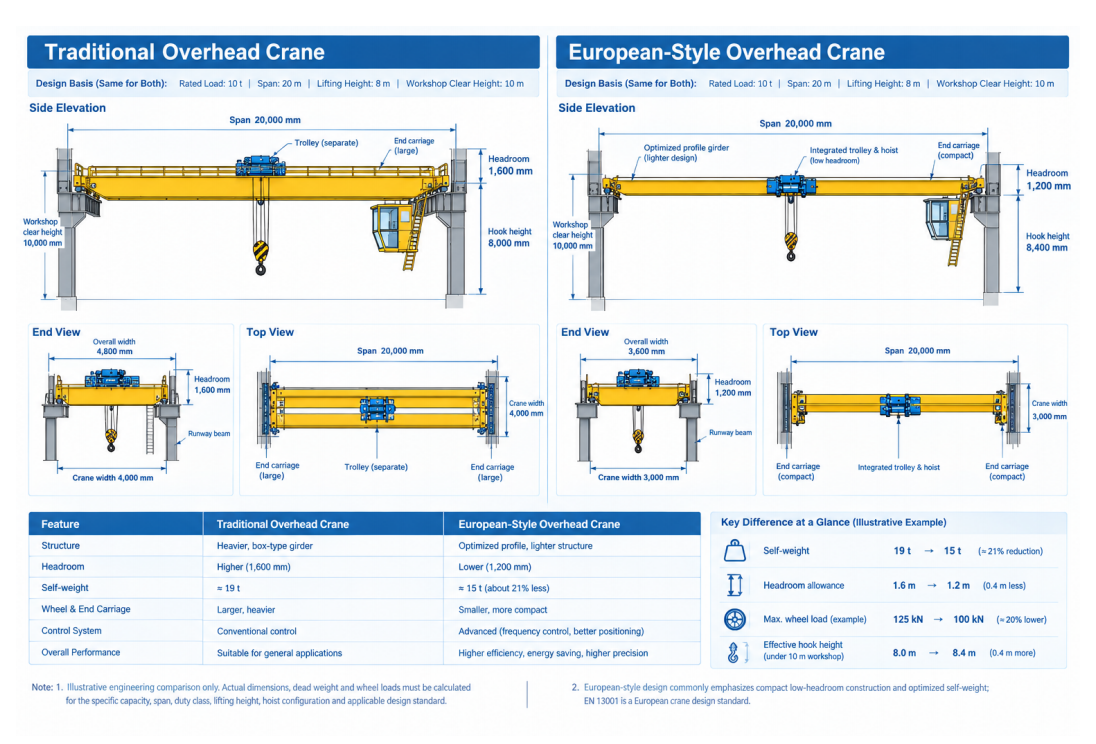
The figures shown in the drawing are for reference only and should not be treated as fixed specifications. In an actual crane design, parameters such as the crane’s self-weight, wheel loads, headroom, hook height, and structural dimensions are determined based on the required lifting capacity, span, lifting height, duty class, operating conditions, hoist configuration, and the applicable design standards.
These factors can vary considerably from one project to another, so the final dimensions and loads need to be calculated for the specific application.
Now, let’s take a closer look at the key differences between the two designs.
From a Design Standards Perspective
European-style cranes and traditional cranes differ in many respects, including their overall design, available headroom, and self-weight. But in our view, the most fundamental difference comes down to the standards and design systems behind them.
Traditional overhead cranes are commonly designed around established general-purpose crane standards, such as GB/T 3811-2008 and GB/T 14405-2011 in China. European-style overhead cranes, however, place greater emphasis on compact structural design, optimized self-weight, low headroom, modular components, and efficient use of workshop space. The key difference is therefore not simply the standard being followed, but how the crane is engineered to meet the required lifting capacity, duty class, operating conditions, and available workshop space.
From a Structural and Design Perspective
When customers first see a European-style crane and a traditional crane side by side, the first thing they usually notice is the size. The traditional crane often looks much larger. However, there is much more to the difference than what you can see from the outside.
The two designs differ throughout the crane—from the main girder and end carriages to the trolley, hoist, drive system, and control system. Understanding these differences gives you a much clearer picture of why European-style cranes are designed the way they are.
The Main Girder and End Carriage Design
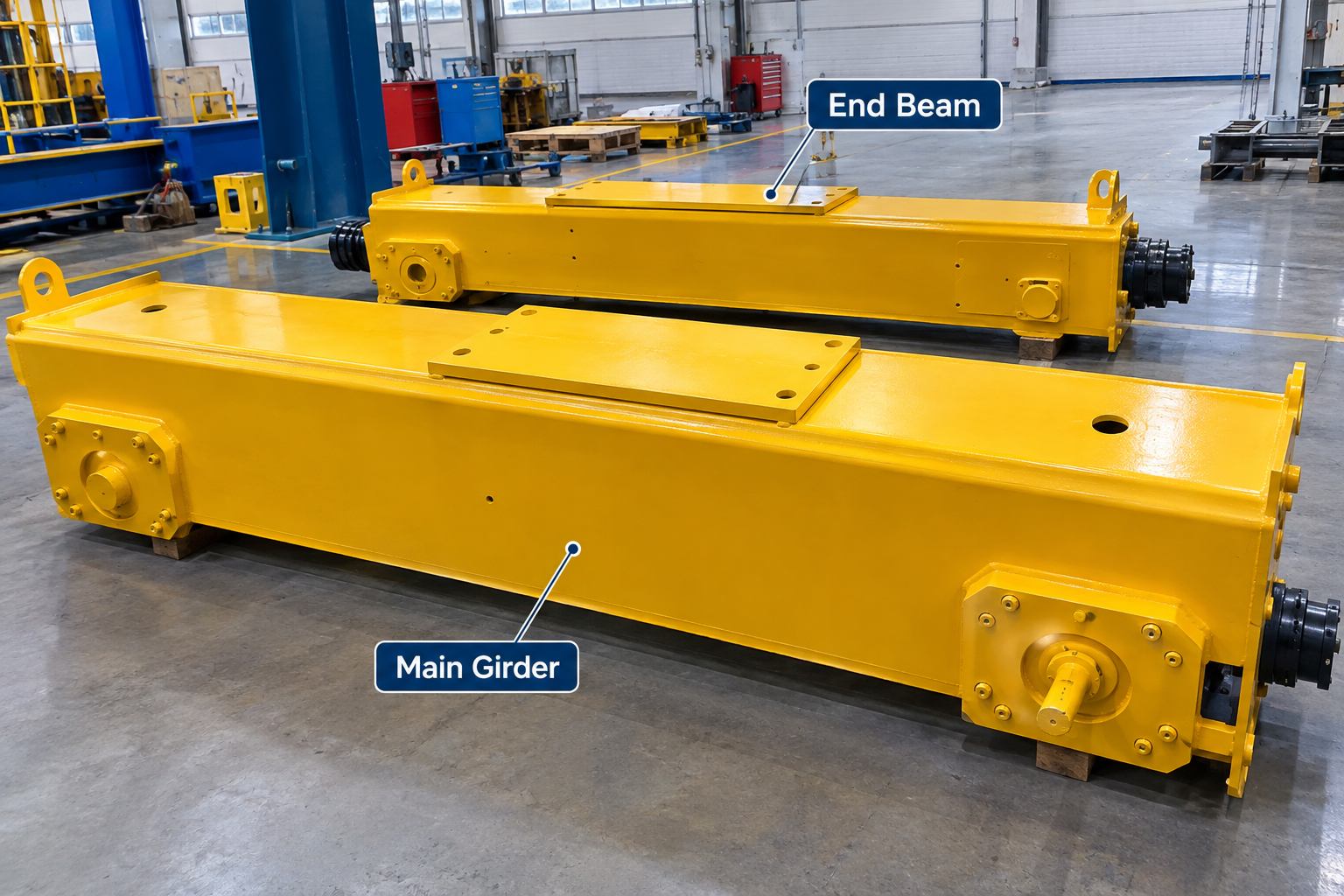
In the crane industry, the main girder and end carriages are generally considered the crane bridge structure.
Traditional cranes tend to have a heavier bridge structure. When the required lifting capacity or span increases, the main girder and related structural components may need to be reinforced with larger sections or additional material to meet the required strength, stiffness, and stability. It is a relatively straightforward design approach: as the load requirements increase, more structural capacity is built into the crane itself.
There is nothing inherently wrong with this approach. Traditional crane designs have been developed and refined over many years, and the manufacturing processes are well established. For many conventional applications, this type of structure can provide the required strength and reliability.
European-style cranes take a different approach. Through lightweight structural design, optimized cross-sections, and finite element analysis (FEA), the bridge structure can be designed to reduce unnecessary self-weight while still meeting the required strength, stiffness, and stability. The structure is calculated based on factors such as lifting capacity, span, duty class, wheel loads, and operating conditions, allowing material to be concentrated where it is actually needed to carry the load.
This is about more than simply making the crane lighter. Reducing the self-weight of the bridge structure can also have a knock-on effect on several aspects of the crane and the supporting building, including:
· Crane Wheel Loads
· Building Load Requirements
· Motor Sizing
· Energy Consumption
· Building Steel Structure Design
Trolley and Hoist Structural Design
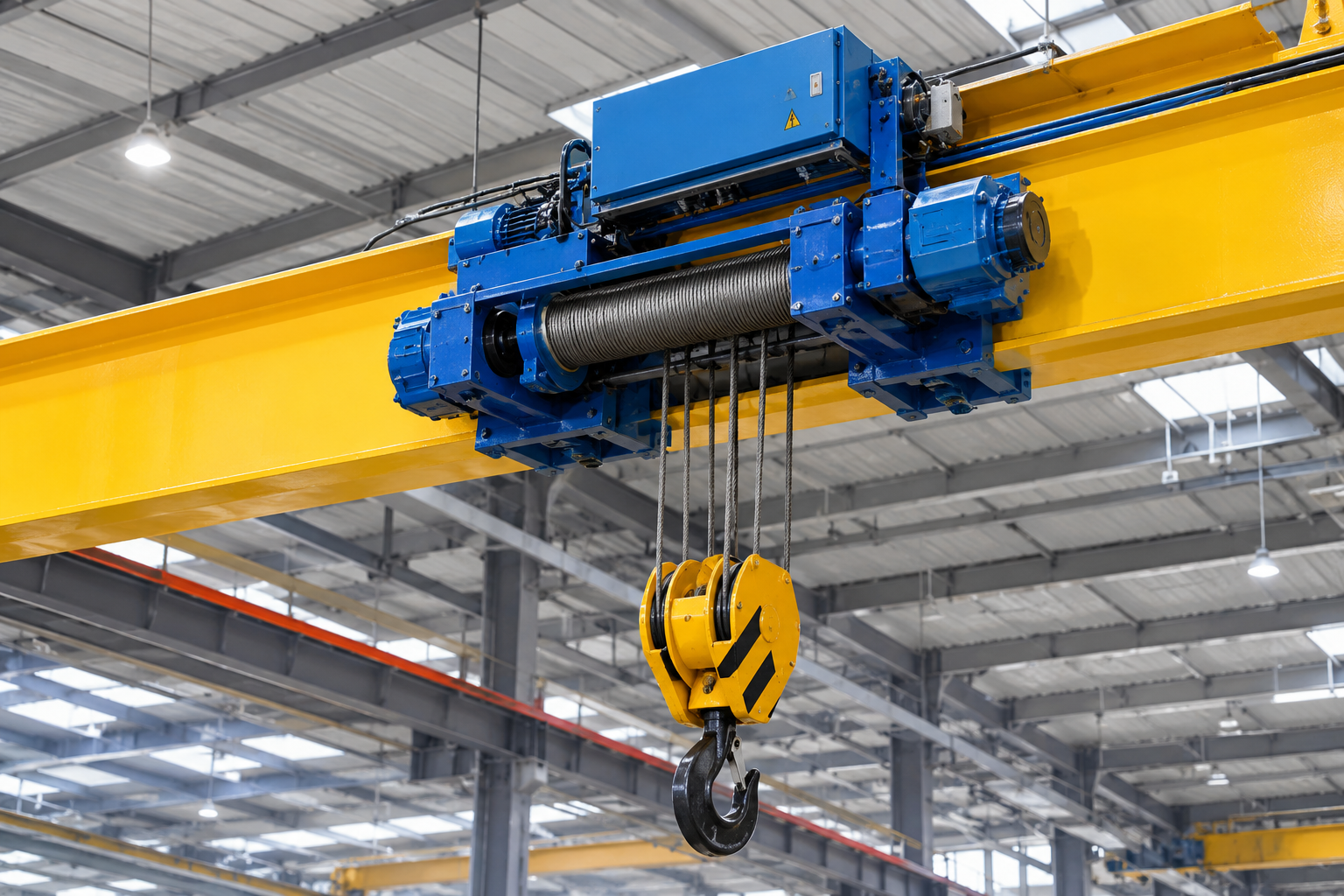
The trolley and hoist are another area where the differences between traditional and European-style cranes become quite noticeable.
Traditional cranes need to accommodate a wide range of operating conditions and customer requirements. For this reason, components such as the trolley, wire rope hoist, motor, brake, gearbox, and other mechanisms are often installed separately on the trolley frame and connected through couplings, drive shafts, and other transmission components. One advantage of this arrangement is that the individual components can be selected according to the required lifting capacity and duty class. The trade-off is that more installation space is needed, simply because each mechanism requires its own space.
European-style cranes take a different approach, with greater emphasis on compact and lightweight design. The hoisting motor, gearbox, drum, brake, and other components are arranged and integrated more efficiently, rather than simply being installed as separate mechanisms on a larger trolley frame. As a result, the hoist and trolley have a more compact overall layout and take up less space.
Reducing the size and self-weight of these components is not just an aesthetic change. A lighter and more compact trolley can also help reduce the overall crane weight and, consequently, the wheel loads imposed on the runway and supporting structure.
How Does a Lighter Crane Structure Affect the Building?
This is a very practical point to consider when comparing traditional cranes with European-style cranes.
A crane does not operate independently of the building structure. The loads generated by the crane are ultimately transferred to the supporting structure through the wheels and runway rails. As a result, factors such as the crane’s self-weight, rated lifting capacity, trolley weight, and dynamic loads all contribute to the wheel loads that the building structure needs to accommodate.
With traditional cranes, the use of heavier structural components and more individually mounted mechanisms generally results in a higher overall crane weight. This can translate into higher wheel loads on the runway and supporting structure.
European-style cranes take a different approach. By optimizing the main girder, end carriages, trolley, and hoisting mechanism, unnecessary structural weight can be reduced while still meeting the required strength, stiffness, stability, and other design requirements. A lighter crane structure can therefore help reduce the wheel loads imposed on the building.
For a new building, these loads can be taken into account during the structural design stage. For an existing building—especially when replacing an older crane or upgrading a workshop—the existing runway and building structure need to be checked to make sure they can safely accommodate the loads from the new crane.
This is why, when we discuss crane selection with a customer, we usually need more information than just the required lifting capacity. We also need to look at the span, lifting height, duty class, building height, runway conditions, and the existing building structure.
All of these factors can influence the final crane design.
From the Drive and Control Systems Perspective
Traditional cranes typically use a well-established, split drive system. The motor, gearbox, brake, coupling, and other components are installed separately, with power transmitted to the wheels or drum through various mechanical transmission components. This approach has been used for many years and has a proven track record. For conventional lifting applications, it can provide the reliability and performance required. The trade-off is that, because the individual components are installed separately, more space is needed for installation and there are more transmission components involved.
European-style cranes take a more compact and integrated approach to the drive system. The travelling mechanism, for example, often uses an integrated drive arrangement in which the motor, gearbox, and braking functions are combined more efficiently, reducing the number of intermediate transmission components. The hoisting mechanism is also selected and matched according to factors such as lifting capacity, lifting speed, duty class, and operating conditions, with the motor, gearbox, and drum designed to work together as a complete system. The goal is not simply to make the equipment smaller, but to reduce unnecessary weight and space requirements while still meeting the required strength, performance, and service-life requirements.
The same principle applies to the control system. Traditional cranes can use contactor-based controls, or variable frequency drives (VFDs) can be added when required by the application. European-style cranes generally place greater emphasis on variable frequency control, allowing the motor acceleration, deceleration, and braking process to be controlled more precisely. This helps the crane start and stop more smoothly, which becomes particularly important when the crane is operated frequently throughout the day.
However, the control system still needs to be selected according to the actual application. For a crane used mainly for routine material handling in a workshop, a reliable basic control system may be more than sufficient. If the application requires frequent positioning, precise stopping, or coordination with a production line or other automated equipment, additional functions such as PLC control, positioning systems, anti-sway control, wireless remote control, or other automation features can be considered.
From the Energy Cost Perspective
Based on what we have seen in actual projects, the crane's self-weight is one factor that should not be overlooked when considering energy consumption over many years of operation.
As discussed above, the traditional crane is generally heavier than a European-style crane, whether you look at the bridge structure, travelling mechanism, or other equipment mounted on the crane. When the crane is operating, the drive system needs to handle not only the load being lifted but also the weight of the crane itself. With a lighter crane structure, less energy may be required for travelling and lifting under comparable operating conditions.
That said, when YunTian design a crane for a customer, we never reduce motor capacity simply to lower energy consumption. Motor selection still needs to be based on the rated lifting capacity, lifting speed, travelling speed, duty class, operating frequency, and daily working hours. If the motor is undersized, it may have to operate under excessive load for extended periods, which can affect its service life and the reliability of the crane.
For us, energy efficiency is therefore not about using the smallest possible motor. It is about matching the motor, drive system, crane structure, and actual working conditions properly. When these factors are considered together, the crane can achieve the required performance without carrying unnecessary weight or using more power than the application actually requires.
Conclusion: Choosing a Crane Based on Your Requirements
From a manufacturer's perspective, there is no absolute answer as to whether a traditional crane or a European-style crane is “better.” The right choice depends on the actual application.
Traditional cranes use a proven split-type structure and have been widely used for many years. For many conventional material-handling applications, this approach remains reliable and practical. European-style cranes place more emphasis on compact drive systems, the integration of mechanical and electrical components, and more precise control during starting, travelling, and braking.
If you are not sure which type of crane is suitable for your application, you can provide us with details such as the lifting capacity, span, lifting height, duty class, operating frequency, and building conditions. Based on these requirements, we can work with you to develop a crane configuration that fits your actual working conditions.


